Blessed Be! Our next sabbat of Mabon will be on September 20th, 2026!

Lughnasadh
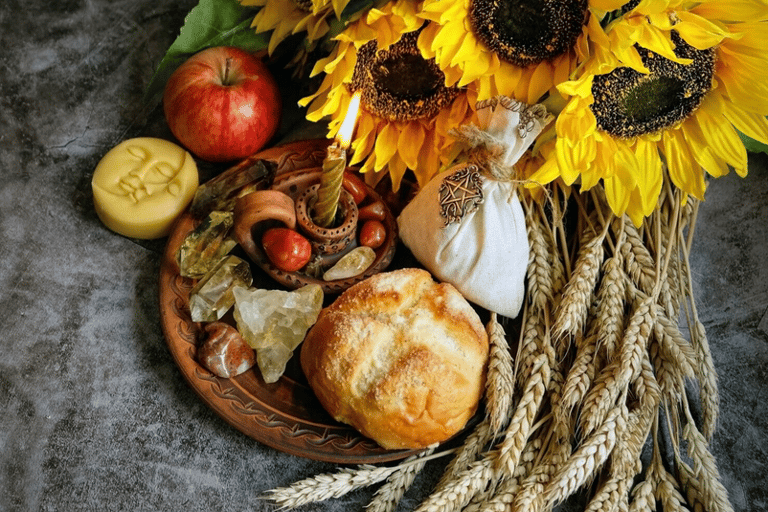
As summer begins to wane, and the fields become adorned with ripening crops, many communities around the world gather to celebrate Lughnasadh, an ancient harvest festival with deep historical roots. Lughnasadh, also known as Lammas, and Frey Fest , holds a special place in cultures around the world,, bridging the gap between our agricultural past and our modern-day practices. In this blog post, we’ll explore the fascinating history of Lughnasadh and how its celebration continues to thrive in contemporary times.
Lughnasadh: This is an Irish Gaelic name for the feast which commemorates the funeral games of Lugh, Celtic god of light, and son of the Sun. In the metaphor story of the Wheel of the Year, the Sun God transfers his power into the grain, and is sacrificed when the grain is harvested. So we have a dying, self-sacrificing and resurrecting god of the harvest, who dies for his people so that they may live. Sound familiar?
Lughnasadh finds its origins in the distant past, where agrarian societies marked the beginning of the harvest season with thanksgiving ceremonies. The festival’s Celtic roots are particularly significant, as Lughnasadh, named after the Irish god Lugh, was celebrated in honor of the deity’s foster mother, Tailtiu. Tailtiu was believed to have cleared the land for agriculture, emphasizing Lughnasadh's connection to the land’s fertility and the fruits of human labor.
Demeter and Persephone are associated with this festival celebration. They are mother and daughter and are personified as a protective love that a mother has for her daughter. Both of these goddess have Greek origins. Most importantly, in relation to Lughnasadh, Persephone is the goddess of harvest and fertility, which is significant to the celebration of this Sabbat due to it being the first of three harvest Sabbats.
As the Roman Empire expanded, it integrated local traditions into its culture, including harvest celebrations. Roman festivals such as Ceresalia and Robigalia were dedicated to Ceres, the goddess of agriculture, and Robigus, the god of grain protection. These festivals likely influenced the development of Lammas, further intertwining ancient customs with regional beliefs.
With the spread of Christianity, early Church leaders sought to co-opt and replace pagan festivals with Christian celebrations. Lammas coincided with the Christian Feast of St. Peter in Chains on August 1st, a day dedicated to the Apostle Peter’s liberation from prison. By blending the religious and agrarian aspects, Lammas retained its significance, even within a Christian framework.
During the medieval period, Lughnasadh played a vital role in feudal societies. It marked the beginning of the harvest, and tenants presented their landlords with offerings, including the “Lammas loaf” made from the first harvested grain. This practice reinforced the social bonds between landlords and peasants, fostering a sense of community and shared responsibility for the land’s abundance.
Lughnasadh is steeped in folklore and traditions, each region infusing the festival with its unique customs. In some areas, farmers created corn dollies as charms to ensure a successful harvest and bring blessings to the community. These corn dollies were often displayed throughout the year and ceremonially burned at the following year’s Lughnasadh, completing the cycle of life and harvest.
Despite the rapid changes in the modern world, Lughnasadh has not been forgotten. Many communities, especially those with Wiccan or Neo-pagan inclinations, continue to honor the festival as a time of gratitude for nature’s bounty and a celebration of the interconnections of all life. Additionally, a resurgence of interest in ancient traditions has sparked renewed Lughnasadh celebrations worldwide.
Lughnasadh has found a place in modern spiritual practices, particularly among those seeking a closer connection to nature and the cycles of life. For some, Lughnasadh offers a time for reflection, setting intentions for the upcoming autumn season. It is a moment to express gratitude for the Earth’s abundance and to reconnect with the land and its resources.
In the face of global challenges like climate change and environmental degradation, Lughnasadh serves as a reminder of the need for sustainable practices. Modern-day celebrations can incorporate discussions on responsible agriculture, ethical consumption, and respect for the Earth’s finite resources.
Lughnasadh stands as a testament to the enduring connection between humanity and the land. From its ancient roots in Celtic and Roman traditions to its modern-day practice among various spiritual communities, Lughnasadh continues to serve as a reminder of our reliance on nature’s gifts. As we celebrate this harvest festival, let us embrace the spirit of gratitude, unity, and sustainability, carrying its lessons into the future for the betterment of our planet and ourselves.
Connect
Reach out with questions or insights. luciddreamer@covenradiantmoon.org
Bright Blessings!
As Above, So Below
© 2026. All rights reserved.