Blessed Be! Our next sabbat of Mabon will be on September 20th, 2026!
Introduction to the Wheel of the Year
History, Meaning and Modern Day Practice
The Wheel of the Year is more than a calendar—it is a living tradition that celebrates the cyclical dance of nature. Although the term itself was coined in the mid‑20th century within Wiccan and neopagan circles, the festivals it unites are rooted in ancient seasonal observances from pre‑Christian Europe. Today, the Wheel serves as a spiritual framework for honoring the changing seasons, connecting with the Earth, and finding meaning in the eternal cycle of life, death, and renewal.
Ancient Origins of Seasonal Observance
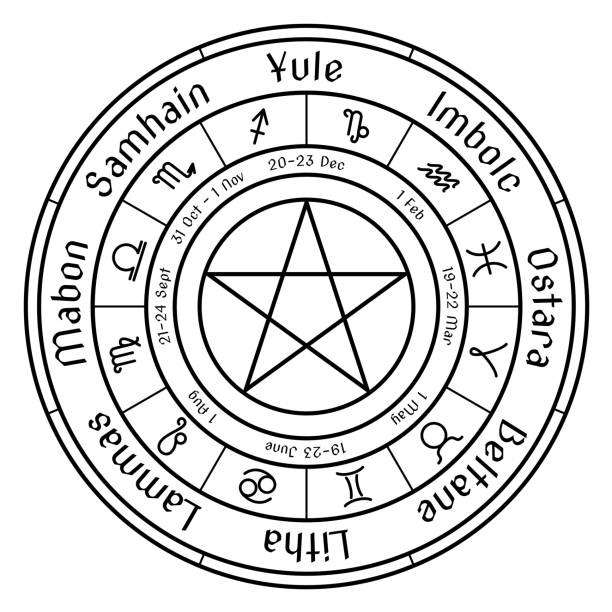
Long before modern paganism, the Celtic peoples of Ireland, Scotland, and Wales marked the year through four major fire festivals:
Samhain (end of harvest, ancestral remembrance)
Imbolc (early spring, purification, Brigid)
Beltane (fertility, protection, beginning of the light half of the year)
Lughnasadh / Lammas (first harvest, craftsmanship, community markets)
These festivals aligned with agricultural cycles and acted as spiritual gateways between seasons. The Celts viewed time as circular rather than linear—an idea that resonates strongly with today’s Wheel
In northern Europe, Norse and Germanic communities held feasts and rituals marking the solstices and equinoxes. Traditions like:
Yule, the midwinter festival of light
Ostara, the spring observance tied to new life and balance
Midsummer / Litha, celebrating abundance and sunfire; influenced later pagan and folk practices across the region.
Mabon: While the this term didn’t see historical use of the term “Mabon,” this was celebrated as the harvest season with feasts and offerings to ensure abundance and protection for winter.
These holidays often blended ancestor veneration, offerings to deities, and celebrations of natural cycles—core elements that remain central today.
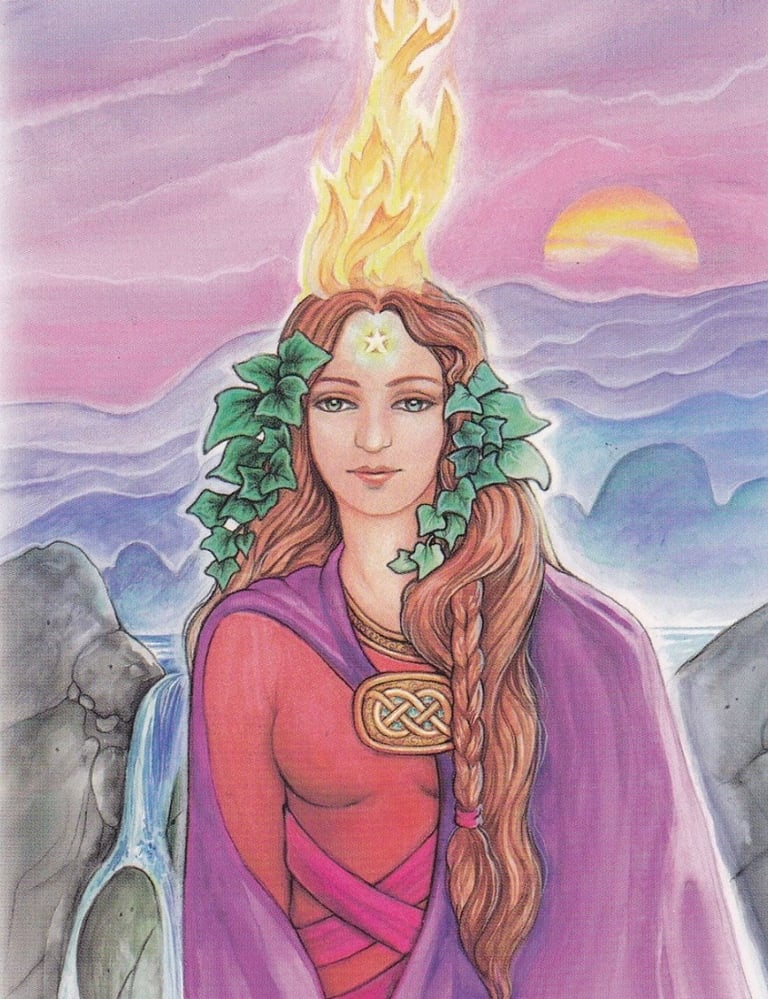
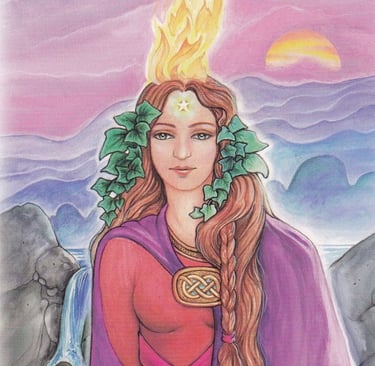
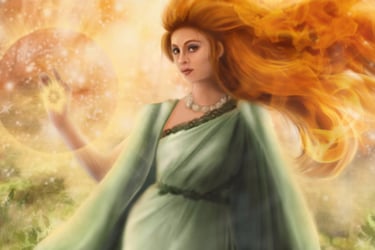
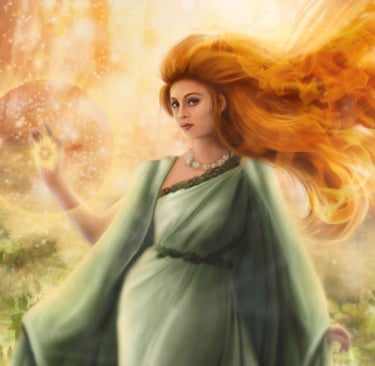
Artwork of Brigid - She is typically associated with Imbolc, which occurs on February 2nd each year.
Early Interpretations and Proto‑Theories
Although no ancient source presents an eightfold ritual year, several influential 19th–20th century scholars began linking disparate European festivals into a broader seasonal pattern:
James George Frazer’s The Golden Bough (1890) attempted to compare European seasonal rites and explore their pagan roots.
Margaret Murray, in The Witch-Cult in Western Europe (1921), cited witch‑trial records suggesting gatherings at “quarter days,” implying an organized seasonal cycle. Although Murray’s theories are now rejected by scholars, her work strongly influenced early Wiccans.
Robert Graves’ The White Goddess (1948) proposed a poetic mythos linking British folk festivals into eight major holidays, a formulation that closely resembles the modern Wheel.
An even earlier precursor came from Jacob Grimm, who in Teutonic Mythology (1835), speculated about a pan‑European seasonal ritual structure. His work later inspired Wiccan founders to formalize the Wheel.
The Modern Creation of the Wheel of the Year
While rooted in ancient practices, the Wheel of the Year as we know it today is a modern synthesis developed during the mid‑20th century, particularly within Wicca:
The eight‑fold structure was solidified in the 1950s–60s by early Wiccan practitioners who combined the four Celtic fire festivals with the four solar quarter days.
British neopagans helped popularize this integrated cycle, merging diverse European traditions into a unified spiritual calendar.
Modern festivals include:
Yule, Imbolc, Ostara, Beltane, Litha, Lughnasadh, Mabon, and Samhain—with dates varying slightly each year.
Cultural Evolution and Continuity
Celtic Contributions
The Celtic fire festivals deeply shape the Wheel’s modern tone. They were originally tied to:
livestock cycles (e.g., Imbolc and spring lambing)
the agricultural calendar (e.g., Lughnasadh and the grain harvest)
beliefs about the spirit world (e.g., Samhain as the time when the veil is thinnest)
These festivals were communal and reflected a worldview where seasons governed social and spiritual life.
Christian Syncretism
As Christianity spread through Europe, many pagan observances were absorbed and reinterpreted:
Samhain became All Saints’ Day and Halloween.
Yule traditions were incorporated into Christmas.
Easter aligned with spring fertility themes associated with Ostara.
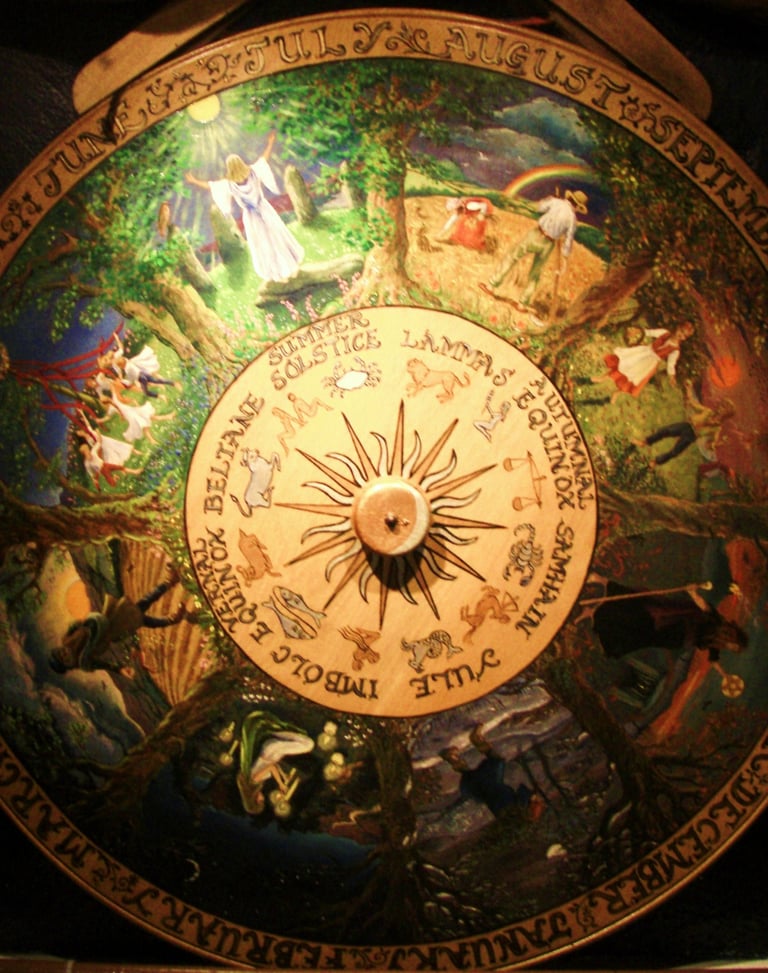
Original artwork by Midnightblueowl
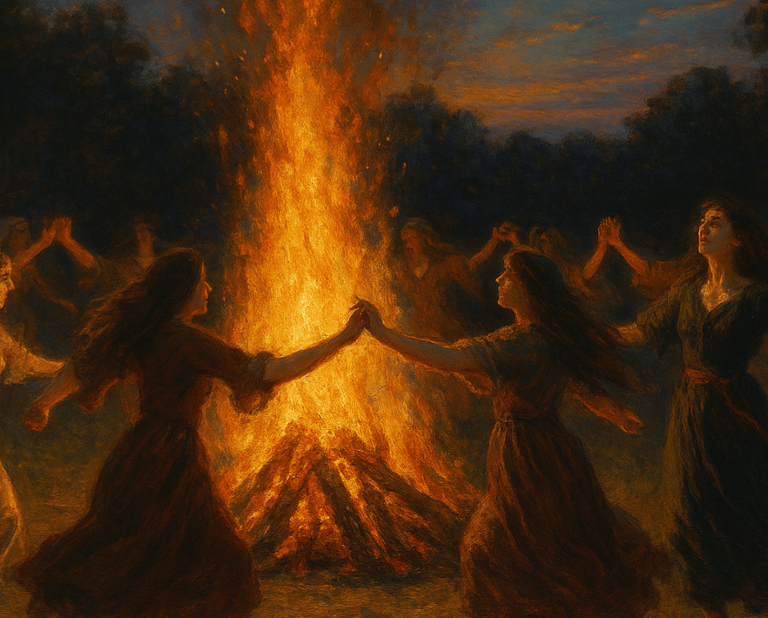
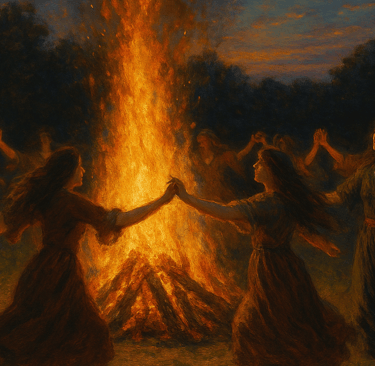
Dancing around a bonfire is a common practice at midsummer
and harvest festivals worldwide.
The Wheel in Contemporary Paganism
Modern paganism is diverse, and practices vary across traditions:
In Wicca, the Wheel is viewed as a spiritual metaphor for life, death, and rebirth, and the festivals are known as Sabbats.
The festivals are used for reflection, gratitude, and reconnecting with the cycles of nature. Some traditions begin the Wheel at Samhain, treating it as the pagan New Year due to its association with the end of the harvest and the beginning of winter.
Contemporary pagan movements, including Wicca, Neo‑Druidism, and Goddess‑centered paths, have embraced the Wheel as a shared framework, even though each group may interpret it differently.
The Wheel of the Year stands today as a powerful symbol of spiritual connection to seasonal rhythms, but its structure is a modern creation. Ancient Europeans did celebrate solstices, equinoxes, and agricultural seasons, yet the unified system now used by pagans emerged primarily in the mid‑20th century through the influences of Wiccan founders, along with historians on folklore and ancient traditions.
Thus, the Wheel is best understood as a revivalist tradition—blending authentic ancient practices, Christianized customs, and modern spiritual innovation into a cohesive cycle that resonates deeply with today’s nature‑based spiritual communities.
Click on any of the images below to explore a sabbat!
Imbolc
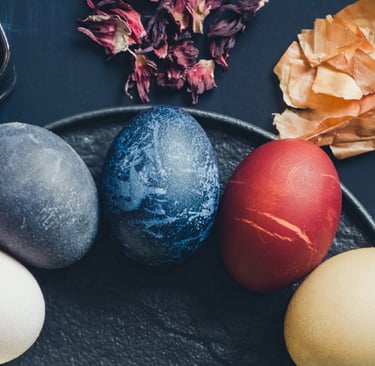
Ostara

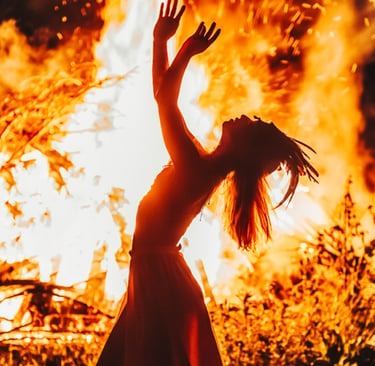
Beltane
Litha
Lughnasadh
Mabon

Samhain
Yule
Connect
Reach out with questions or insights. luciddreamer@covenradiantmoon.org
Bright Blessings!
As Above, So Below
© 2026. All rights reserved.