Blessed Be! Our next sabbat of Mabon will be on September 20th, 2026!
Mercury
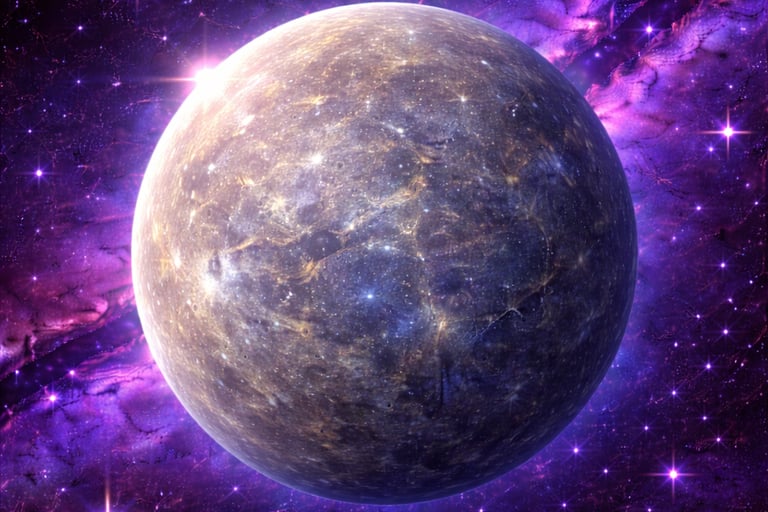
☿ Mercury — The Messenger of the Cosmos
Astronomical Type: Terrestrial Planet
Astrological Role: Communication, Intellect, Exchange
Rulership: Gemini & Virgo
Orbital Period: ~88 Earth days
🪐 Introduction: Thought, Language, and Connection
Mercury is the closest planet to the Sun and, in astrology, represents the realm of thought, communication, and perception. It governs how we process information, express ideas, and connect with others.
As the fastest-moving planet in the solar system, Mercury symbolizes speed, adaptability, and mental agility. It is the force that translates inner experience into words, ideas into action, and knowledge into shared understanding.
🏺 Ancient Origins: The Divine Messenger
Mercury’s significance dates back to ancient Mesopotamian and Egyptian astronomy, where it was observed as a swift-moving celestial body that appeared briefly at dawn or dusk. Because of its elusive nature, it was associated with messengers, intermediaries, and divine communication.
In Babylonian culture, Mercury was linked to Nabu, the god of writing, wisdom, and scribes. Nabu was believed to record the fate of individuals, reinforcing Mercury’s connection to language, knowledge, and the transmission of information.
🪽 Mythological Identity: Hermes and Mercury
In Greek mythology, Mercury corresponds to Hermes, while in Roman tradition it is known as Mercury, the messenger of the gods. This deity was known for:
Winged sandals, allowing swift travel
The caduceus, a staff symbolizing communication and exchange
The ability to move between worlds—Olympus, Earth, and the Underworld
Mercury/Hermes was not only a messenger but also a trickster, guide, and translator, embodying intelligence, wit, and versatility. This mythological identity reflects Mercury’s astrological themes of:
Communication and language
Movement and travel
Mediation and interpretation
Cleverness and adaptability
🧠 Astrological Influence: The Mind and Its Expression
In astrology, Mercury governs the mental realm—how we think, learn, and communicate. Its placement in a birth chart influences:
Communication style (direct, analytical, expressive)
Learning preferences and intellectual strengths
Decision-making processes
Social interaction and conversation
Mercury’s dual rulership over Gemini and Virgo highlights its range:
In Gemini: curious, quick, and conversational
In Virgo: precise, analytical, and detail-oriented
This duality reflects Mercury’s ability to operate in both broad exploration and focused refinement.
🔄 Retrograde Motion: Reflection and Recalibration
Mercury is well known for its retrograde cycles, periods when it appears to move backward in the sky. Astrologically, these times are associated with:
Miscommunication and misunderstandings
Delays in travel or technology
Revisiting past ideas or unfinished business
However, Mercury retrograde is not inherently negative—it serves as a time for:
Reflection and reassessment
Revising plans and perspectives
Strengthening clarity before moving forward
It reinforces Mercury’s deeper role as a guide through both forward motion and necessary pause.
☀️ Symbolism: Speed, Duality, and Translation
Mercury’s proximity to the Sun and rapid orbit give it a unique symbolic role as:
The bridge between inner and outer worlds
The translator of thought into language
The connector between people, ideas, and systems
The embodiment of duality—logic and intuition, speech and silence
It represents the constant motion of the mind and the endless flow of information that shapes human experience.
✨ Final Reflection
Mercury is the zodiac’s messenger—the force that transforms thought into communication, curiosity into knowledge, and connection into understanding. Rooted in ancient mythology, celestial observation, and the archetype of the divine messenger, Mercury reminds us that how we think and speak shapes the world around us.
It asks a quicksilver question:
“What are you trying to say—and are you truly being understood?”
Connect
Reach out with questions or insights. luciddreamer@covenradiantmoon.org
Bright Blessings!
As Above, So Below
© 2026. All rights reserved.